In the order it reaches you

What You're Actually Watching

The procession arrives in one fixed order, and every part has a meaning. Here’s how to read it.

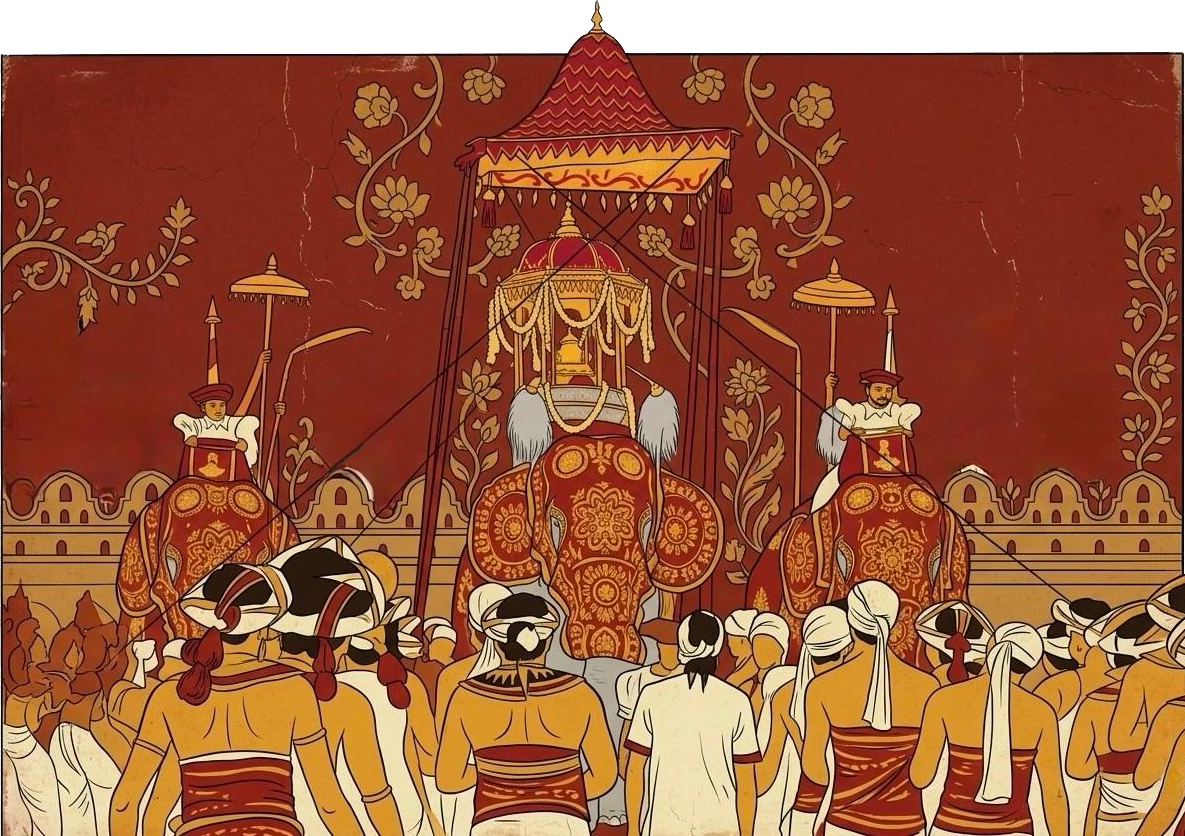
This procession has been held without interruption since King Kirti Sri Rajasinha pledged that the Sacred Tooth Relic be carried through the streets of Kandy every year, making it among the oldest continuously observed processions in the world. What you are watching has not changed in its essential form for centuries.

The Ēsela Perahāra is a sequence: nothing in it is random. But there is a deeper frame: the entire procession is structured as a prayer for rain. The whips call thunder, the fire dancers bring lightning, and the relic moves on white cloth as the rains are summoned from the sky. Every element has a place in that asking. Once you read it that way, the sequence becomes legible.

The Procession

Eight Acts, One Sacred Sequence

Kasakarayo

The whip-crackers

The sound of thunder, before you see anything
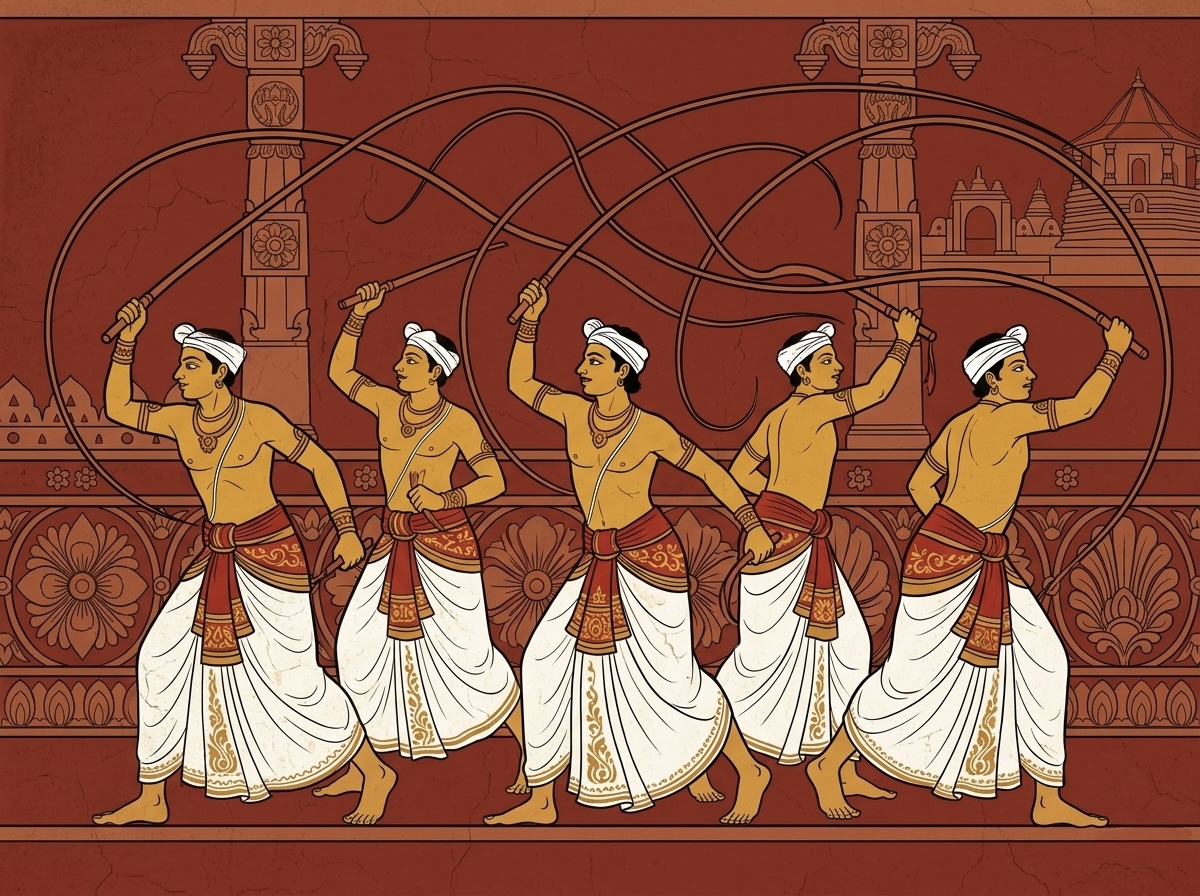
Kandyan mural illustration of Kasakarayo — the whip-crackers who open the Ēsela Perahāra
Kasakarayo: opening the procession with the sound of thunder
You see

Men cracking whips nearly seven feet long, natural-fibre ropes that snap as sharp as a gunshot, at the very head of the procession.

What it means

The crack is the sound of thunder: the procession opens by calling the rains. The craft is hereditary; before the night begins, the knots in each whip are untied, a gesture that mirrors the untying of life’s troubles. When you hear them, the relic is on its way.
Gini Keli

The fire dancers

Lightning before the rain

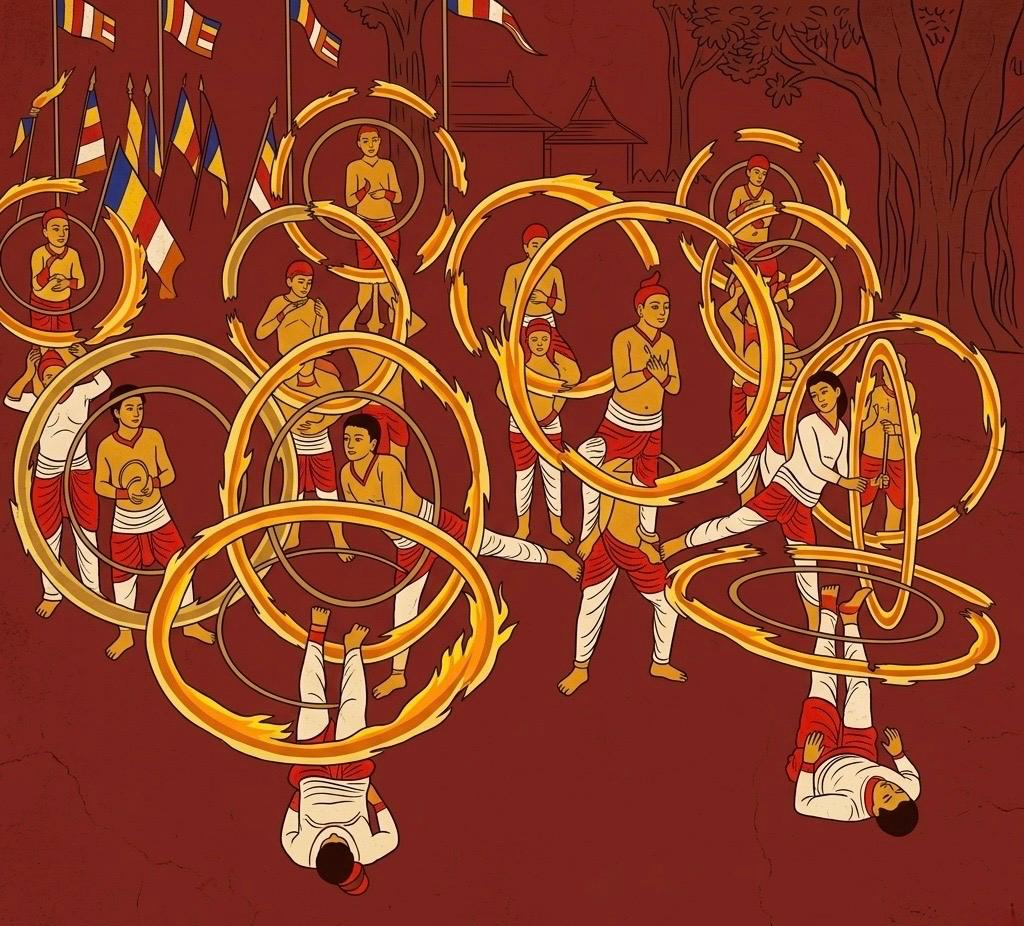
Kandyan mural illustration of Gini Keli — fire dancers performing at three levels in the Ēsela Perahāra
Gini Keli: fire offered at earth, mid-air, and sky to call the rains
You see

Performers whirling chains and balls of fire at three distinct heights: low to the ground, at mid-level, and arcing high above their heads.

What it means

Fire dancers represent the lightning that comes before the rain. They offer fire in order to ask for water. The three heights have names: bim (earth), meda (mid-air), ahas (sky). It is a structured offering across all three realms.

Peramuna Rala

Flag bearers & the Front Official

The man no one may walk ahead of

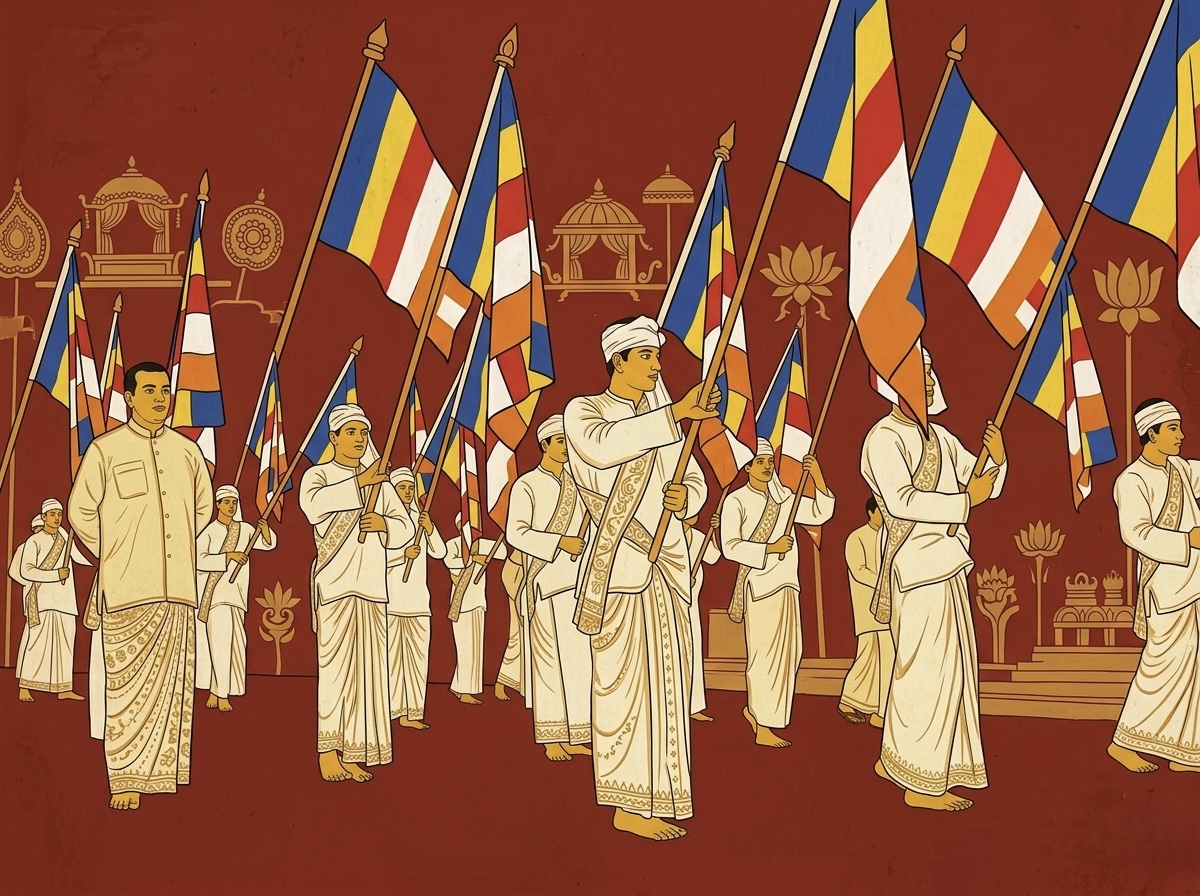
Kandyan mural illustration of the flag bearers carrying the six-coloured Buddhist flags
The six colours: the aura of the Buddha at enlightenment
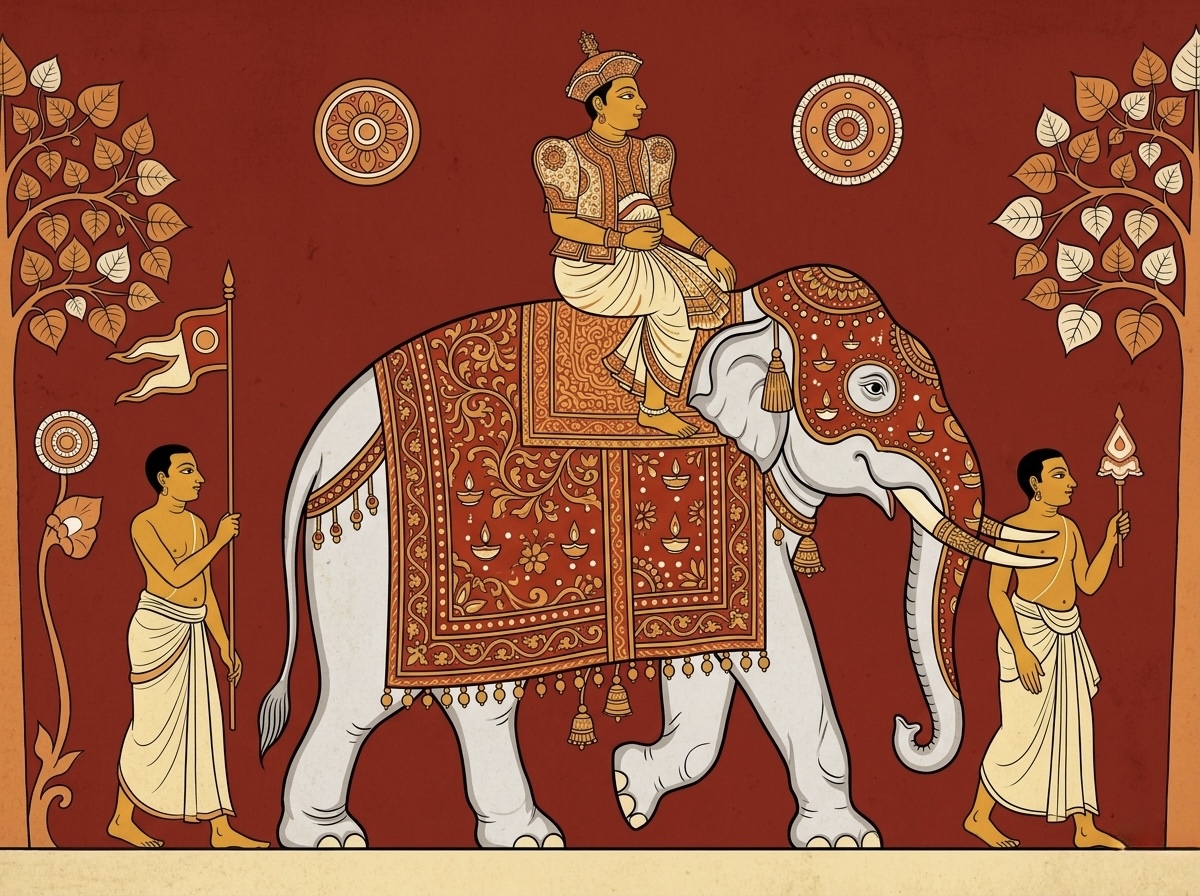
Kandyan mural illustration of the Peramuna Rala riding the first elephant
The Peramuna Rala: no one may walk ahead of him
You see

Rows of flags in the six colours of the Buddhist flag, each representing one of the radiant auras of the Buddha at enlightenment, then an official riding the first elephant. Many of the flag-bearers come from the nearby Pallekele open prison, one of the procession’s quieter traditions.

What it means

The Peramuna Rala formally opens the procession on behalf of the Temple of the Tooth; by protocol, no one may walk ahead of him. The six colours of the flags are not decorative. They are the aura that surrounded the Buddha at the moment of enlightenment.

Geta Bera

The Kandyan drummers

The music no other part may begin before

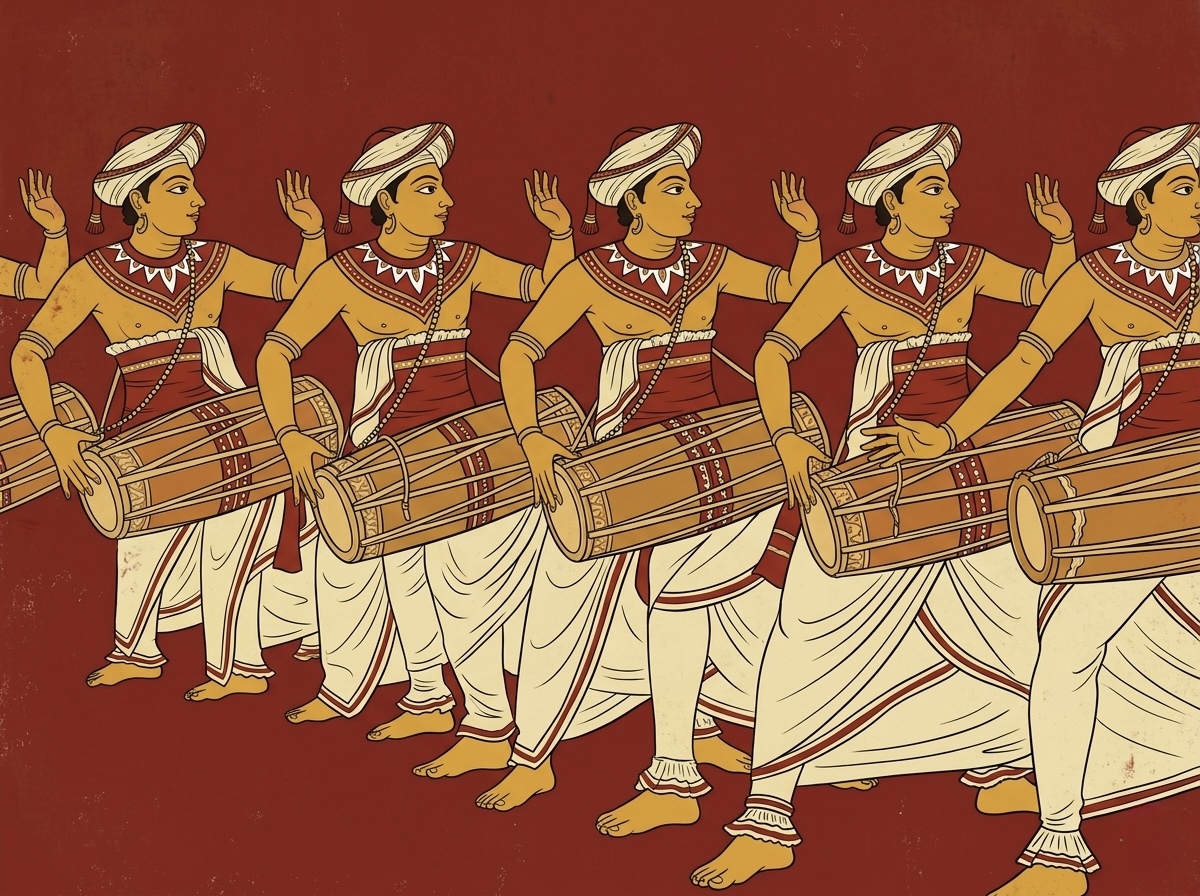
Kandyan mural illustration of the Geta Bera drummers — the panchaturya ensemble of the Ēsela Perahāra
Geta Bera: the Kandyan drummers, whose rhythms the whole procession follows
You see

Lines of drummers playing the double-headed geta bera in tight, thunderous unison: the lead ensemble of the five-fold panchaturya.

What it means

By ancient custom, no other music in the procession may sound before the Hewisi drummers. Their rhythms are a centuries-old ceremonial language: specific patterns mark sacred moments and set the pace for every dancer and elephant that follows.

Read more about the drumming and music groups →

Ves

The Kandyan dancers

The highest form of Kandyan dance, earned not assigned

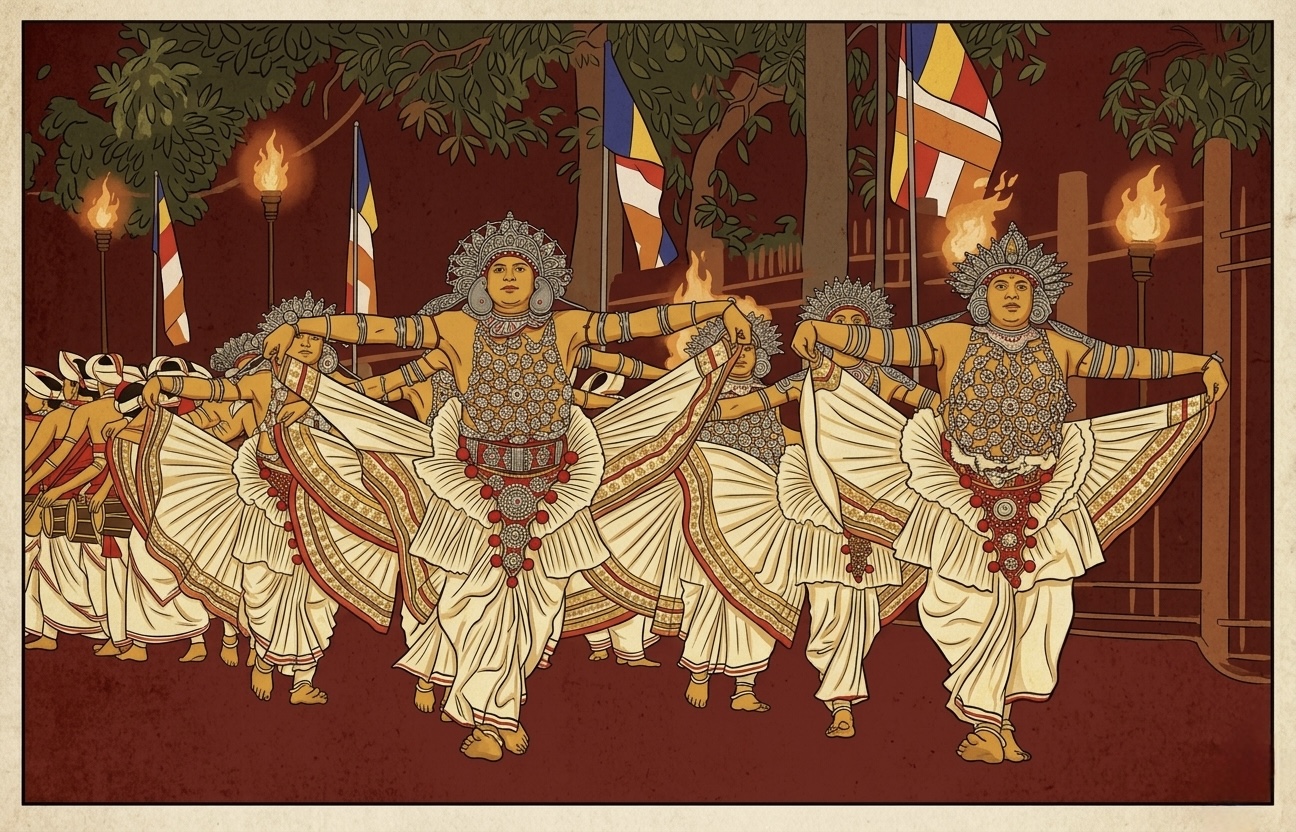
Kandyan mural illustration of a Ves dancer in full sacred costume with silver headdress
Ves: the sacred Kandyan dance costume, earned not given
You see

Dancers in beaded silver headdresses, the iconic Ves costume, anklets ringing, moving in precise choreographic sequence.

What it means

The Ves is the highest form of Kandyan dance, and the costume is considered sacred. A dancer must first master the lower forms before earning the right to wear it; the tradition passes through hereditary families. You’re watching an art form older than any record of it.

Read more about the dance troupes you’ll see →

Aliya

The elephants

Dozens of them, caparisoned and lamp-lit

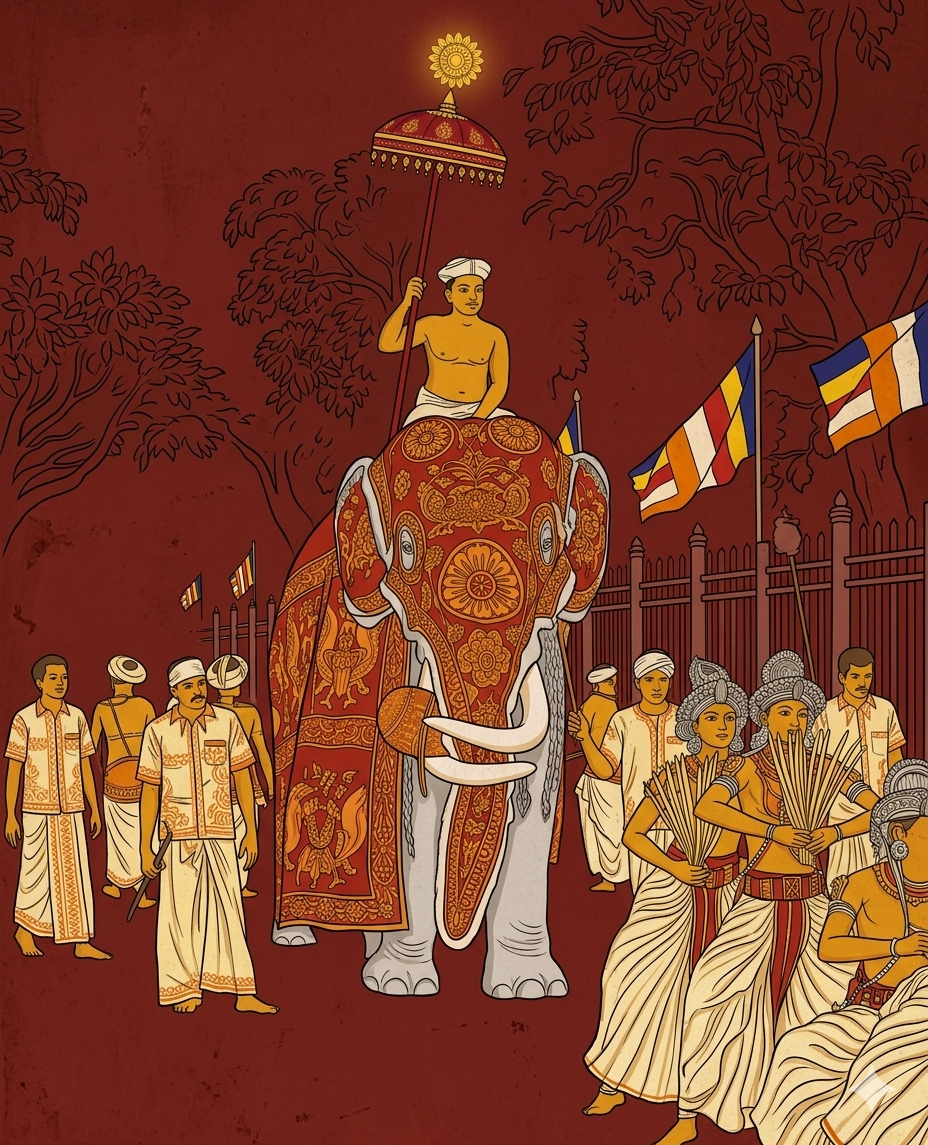
Kandyan mural illustration of Aliya — caparisoned elephants bearing officials and offerings in the Ēsela Perahāra
Aliya: dozens of caparisoned elephants, lamp-lit, moving through the Kandyan night
You see

Elephants draped in embroidered cloth and lit with tiny electric lamps, each attended by fan-bearers and parasol-bearers moving alongside them on foot.

What it means

Some of these elephants have served the Perahāra for decades. Each carries officials and offerings of the temple and the shrines. On the grandest Randoli nights there can be over a hundred, an honour that has no parallel in any other procession on the island.

Maligawa Tusker

The sacred tusker & the golden casket

The heart of the entire festival

The Maligawa Tusker bearing the ranhilige through the streets of Kandy, walking on white pavada cloth
The Maligawa Tusker bearing the ranhilige through the streets of Kandy: the sacred centre of the Ēsela Perahāra
You see

The great Maligawa Tusker, flanked by two others, bearing a golden casket (the ranhilige) under a canopy, stepping only on a length of white cloth rolled out before it.

What it means

The casket carried in the procession is a revered replica made for this purpose alone; it houses 32 relics and honours the Sacred Tooth. The true Tooth Relic remains enshrined in the temple. What passes through the streets is its sacred representative. The white cloth, the pavada, ensures the bearer of the relic never touches bare ground. This is the moment the people waiting since dawn came for.

The pavada: white cloth laid so the sacred never meets the earth.

Diyawadana Nilame

The keeper of the relic

He walks where the king once walked

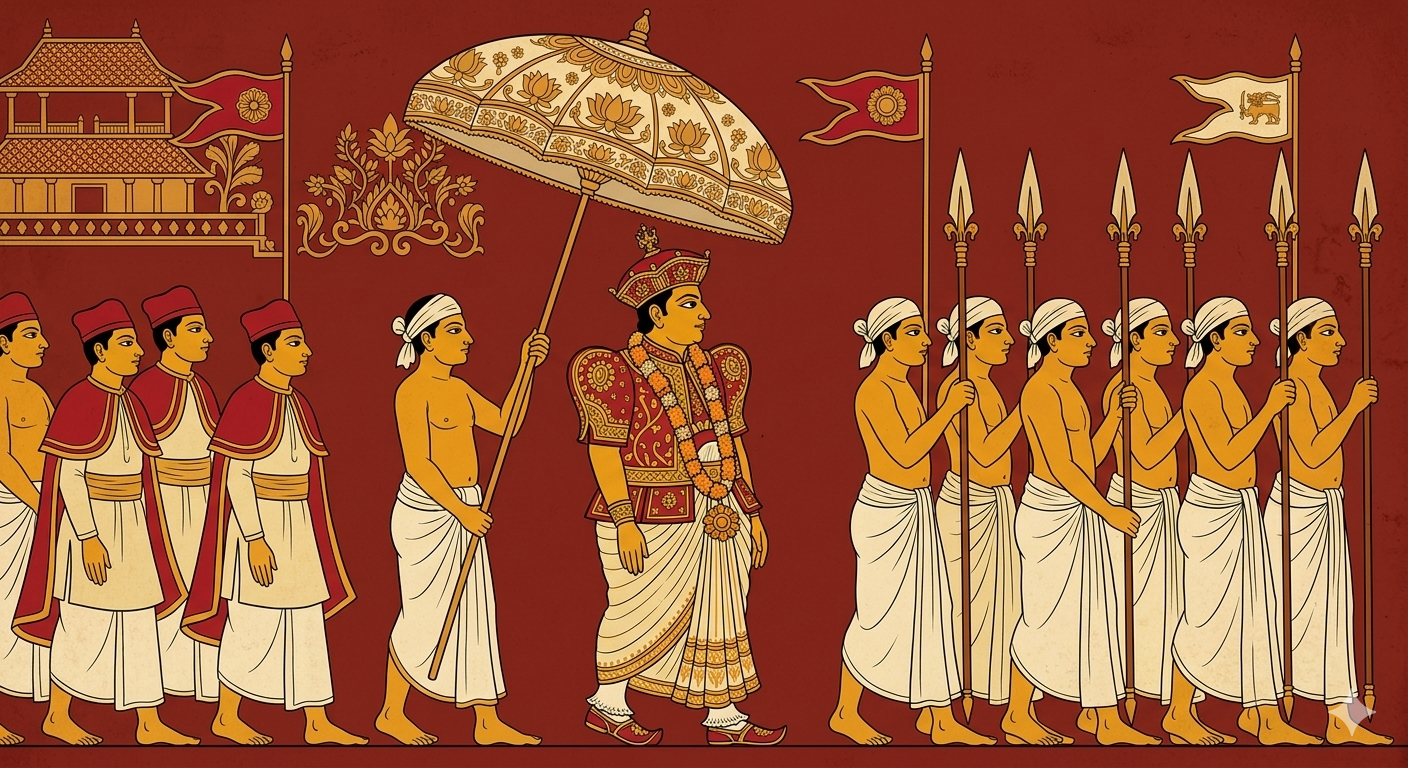
Kandyan mural illustration of the Diyawadana Nilame — the chief lay custodian of the Temple of the Tooth, in full court dress
The Diyawadana Nilame: he walks where the king once walked, in the last surviving costume of the Kandyan court
You see

A man in full Kandyan court dress, the most elaborate costume in the entire procession, walking directly behind the tusker, attended on all sides.

What it means

The Diyawadana Nilame is the chief lay custodian of the Temple of the Tooth; he stands now where the king once stood. He walks behind the relic out of reverence, never ahead. By tradition, his prayers and rituals are held to invoke the seasonal rains, the responsibility carried at the very end of the procession, after everything else has asked. His court dress is one of the last surviving expressions of the Kandyan kingdom.

Five in One

One procession of the Buddha,
four of the gods

The Ēsela Perahāra is really five processions moving together. The first belongs to the Temple of the Tooth. The other four come from the devales, the shrines of four guardian deities, each with its own drummers, dancers and elephants.

  • Maligawa

    The procession of the Sacred Tooth Relic, from the Dalada Maligawa, the sacred centre of all five. The four devale processions follow in its wake; everything in the night moves in relation to it.

    The full story →
  • Natha

    The first of the four devale processions, and for a reason: Natha is the bodhisattva next in line to attain Buddhahood, the deity closest in nature to the Buddha whose relic leads everything. The oldest shrine in Kandy.

  • Vishnu

    Guardian deity of Lanka and protector of the Buddhist faith on the island. His procession follows Natha’s, and the two together represent the continuity of the teaching and its earthly protection.

  • Kataragama

    God of war and protection, whose vehicle is the peacock. Venerated across all communities in Sri Lanka: Buddhist, Hindu, and beyond. His presence in the procession draws the most fervent vows.

  • Pattini

    Goddess of healing and fertility, called on against disease and drought. Hers is the only all-female dancer troupe in the entire procession, a distinction upheld without interruption for centuries.

Now you try

Put the procession in order

Eight acts, shuffled. Tap a tile to select it, then tap another to swap them, get the mural illustrations back into the order they appear in the procession.

    Now you know what passes

    See which night to go.